


Feed Pusher vs. Manual Pushing: The Real Cost Comparison
Feed Pusher vs. Manual Pushing: The Real Cost Comparison
Every dairy and beef operation faces the same daily math problem: feed pushed to the fence at 6 a.m. doesn't stay there. Cows nose it out of reach within an hour, and from that point on, every minute it sits out of reach is a minute of lost dry matter intake (DMI) — and lost milk. The real question isn't whether to push feed. It's how you push it, and what that choice is quietly costing you once labor, fuel, equipment wear, and missed milk are all added up.
This guide breaks down the real, line-by-line cost of three approaches — manual/tractor pushing, a compact electric feed pusher, and a fully autonomous feed-pushing robot — so you can see exactly where your money is going today, and where it doesn't have to.
Key takeaways
- Cows need feed pushed back 12–18 times a day to stay consistently within reach — most manual routines manage only 3–6.
- Manual/tractor pushing typically costs a mid-size dairy $14,000–$18,000+ a year once labor and dedicated fuel/maintenance are counted.
- The HerdMech Electric Feed Pusher ($4,500–$5,200) cuts fuel and equipment costs and often pays for itself in under a year.
- The HerdMech Autonomous Feed Pusher Robot ($33,800) removes the labor task entirely and can push feed hourly, 24/7 — priced roughly 40–50% below comparable Western-brand autonomous units.
Why Push-Up Frequency Matters More Than Most Farms Realize
Feed push-up isn't just tidiness — it's a feeding-behavior intervention. Cows are most likely to visit the bunk right after fresh feed is delivered and right after each push-up. Leave a long gap, and dominant cows crowd the fence while timid cows, first-calf heifers, and lame cows wait longer, eat less, and produce less.
A 2023 dairy trial published in the Journal of Central European Agriculture tracked milk yield across five push-up frequencies. Moving from 2 push-ups a day to 6 raised average milk production from roughly 24.5 kg/cow/day to 26.0 kg/cow/day — about 1.5 kg more milk per cow, per day, from frequency alone. Other university trials found the effect size depends heavily on housing type and bunk space per cow, which is exactly why the how of pushing feed matters as much as the how often.
Industry sources tracking commercial dairies note that feed typically needs to be bladed back to the fence 12–18 times per day to stay consistently within reach — a schedule that's genuinely difficult to hit with a tractor and a single operator juggling five other chores.
The Real Cost of Manual and Tractor-Based Feed Pushing
"Manual pushing" rarely means someone with a broom — on most farms it means a skid-steer or tractor blade, run by an employee, several times a day. That looks free because the tractor is already on the farm. It isn't.
- Labor hours: One commonly cited case of a 250-cow dairy found staff were spending about 2.5 hours a day on feed push-ups alone before automating the task. At a modest $18–20/hour, that's $13,000–$18,000 a year in labor for one task.
- Fuel and maintenance: A tractor or skid-steer dedicated to feed pushing typically runs $1,500–$1,700 a year in diesel and upkeep, on top of whatever it costs to buy or lease the machine.
- Consistency gaps: Nights, weekends, and short-staffed days are where manual pushing falls apart. Even a well-run team rarely exceeds 4–6 pushes a day — well short of the 12–18 needed to keep feed reliably in reach.
- Wear on shared equipment: Using the farm's main tractor or loader for feed pushing adds hours and blade wear to a machine also needed for manure, bedding, and feed delivery — creating scheduling conflicts during busy seasons.
None of this shows up as a line item labeled "feed pushing cost" on the farm's books — which is exactly why so many operations underestimate it.
Two Ways to Automate: Semi-Automatic vs. Fully Autonomous
Once a farm decides manual pushing is costing too much in labor and consistency, there are two realistic upgrade paths. HerdMech builds both.
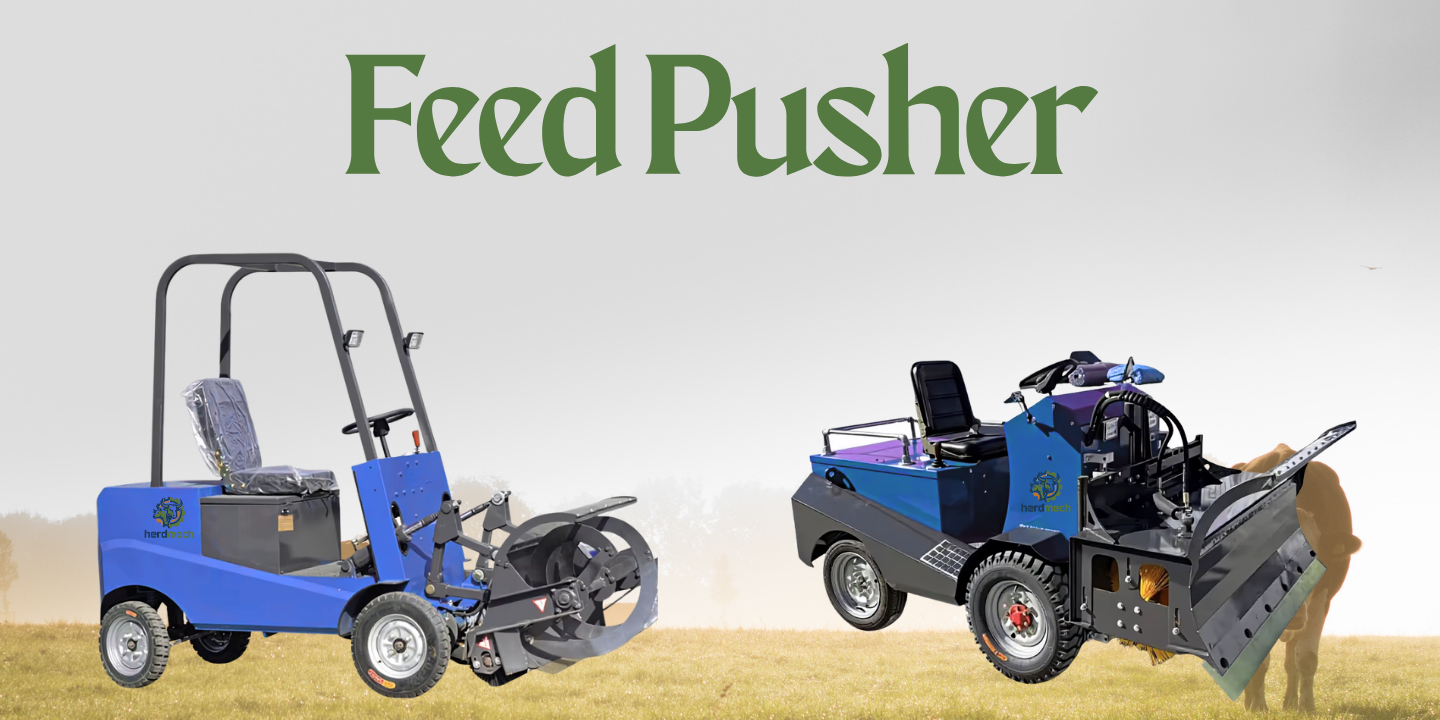
Option 1: HerdMech Electric Feed Pusher — Low-Cost, Operator-Driven

Priced from $4,500–$5,200, the HerdMech Electric Feed Pusher is the entry point into powered feed pushing. It replaces a full-size tractor for this one job with a compact, single-operator, zero-emission machine built specifically for feeding.
- Drive motor: 3,000W electric | Push/auger motor: 2,000W
- Speed: 0–25 km/h | Range: up to 100 km per charge
- Weight: 350 kg — light and agile enough for narrow cowsheds a tractor can't turn in
- Battery: lead-acid or lithium, buyer's choice
- Push & sweep curved bucket continuously turns feed to prevent secondary fermentation and heating at the bunk
It still needs an operator, but it swaps diesel for electricity, cuts the machine's footprint and turning radius dramatically, and is purpose-built so one person can finish a pass faster and with far less physical strain than wrestling a tractor blade down a feed alley. Full specs are on the Electric Feed Pusher product page.
Option 2: HerdMech Autonomous Feed Pusher Robot — Labor-Free, 24/7

At $33,800, the HerdMech Autonomous Feed Pusher Robot removes the operator from the equation entirely. It navigates independently and can push feed as often as your barn layout allows — hourly, if you want it.
- Navigation: LiDAR + vision + IMU sensor fusion, centimeter-level accuracy
- Runtime: 20+ hours per charge, standby ≥1 week, automatic wireless fast charging (~3.7 hrs)
- Coverage: a single robot can typically service 2–4 barns
- Climbing angle: ≥15° | Operating range: -30°C to 60°C | Protection: IP56/IP65
- Cloud dashboard, smartphone app control, forage-recognition feedback, and a full obstacle-detection safety suite (LiDAR, camera, e-stop, safety contact edge)
Full specifications are on the Autonomous Feed Pusher Robot product page.
Feed Pusher vs. Manual Pushing: Side-by-Side Cost Comparison
| Factor | Manual / Tractor Pushing | HerdMech Electric Feed Pusher | HerdMech Autonomous Robot |
|---|---|---|---|
| Upfront cost | Often "free" if using an existing tractor; a dedicated pusher tractor runs roughly $25,000–$30,000 | $4,500–$5,200 | $33,800 |
| Daily labor | ~2–2.5 hrs/day for a mid-size herd; 1 dedicated operator | Reduced per-pass time; still needs one operator | Zero — runs unattended once configured |
| Fuel / energy cost | Diesel + maintenance, roughly $1,500–$1,700/year for a dedicated pusher tractor | Electric — no diesel; low per-kWh running cost | Electric — minimal running cost, no diesel |
| Realistic push frequency | Usually 3–6x/day; nights and weekends often skipped | Higher than manual scraping — passes are quicker and less physically demanding | Up to hourly, 24/7, including nights and holidays |
| Barn / aisle fit | Needs turning space; struggles in narrow or tie-stall barns | Compact, tight turning radius — built for narrow cowsheds | Automatic route planning adapts to barn layout, including multi-barn routes |
| Best fit | Very small herds, or farms with idle labor already available | Small-to-mid farms wanting labor relief at low upfront cost | Mid-to-large or multi-barn operations wanting 24/7 consistency with minimal headcount |
A Worked Example: 200-Cow Barn
Numbers make this concrete. The assumptions below are illustrative — plug in your own labor rate, milk price, and current push-up routine to get a farm-specific figure.
Manual / tractor pushing
~2 hrs/day labor at $18/hr ≈ $13,100/yr, plus ~$1,600/yr fuel & maintenance
≈ $14,700/year ongoing — before the tractor's purchase price
Electric Feed Pusher — $4,600
Eliminates the dedicated tractor's diesel and upkeep cost immediately.
Often pays for itself in well under a year on fuel/maintenance savings alone
Autonomous Robot — $33,800
Removes the ~$13,100/yr labor line and enables hourly push cycles. A conservative 1 kg/cow/day milk-yield lift across 200 cows adds ~200 kg of milk daily.
Many operations recover the cost in 1–2 years — faster than the 2–3+ year payback typical of $60,000–$65,000 competing robots
Which Option Is Right for Your Farm?
- Under 100 cows, tight labor budget: The Electric Feed Pusher usually offers the fastest, lowest-risk payback — low purchase price, no diesel, and a machine sized for smaller barns.
- 100–300 cows, one or two barns, chronic labor shortage: This is the sweet spot for the Autonomous Feed Pusher Robot — enough animals for the milk-response upside to matter, and enough labor pressure that removing a daily task is a real relief.
- 300+ cows or multi-barn sites: A single autonomous robot can typically cover 2–4 barns, so the per-barn cost of automation drops further as the operation scales.
- Currently relying on a shared tractor or skid-steer: Either HerdMech option frees that machine up for manure, bedding, and feed-delivery duties it's also needed for — a benefit that rarely makes it into ROI spreadsheets but shows up immediately in daily scheduling.
Frequently Asked Questions
How much does an automatic feed pusher cost?
HerdMech's lineup ranges from $4,500 for the manned Electric Feed Pusher up to $33,800 for the fully autonomous, LiDAR-guided Feed Pusher Robot — well below the $60,000+ typically quoted for comparable Western-brand autonomous units.
Do feed pushers actually save labor, or just shift it?
A manned electric feed pusher still needs an operator but removes diesel and tractor-scheduling overhead. A fully autonomous robot removes the labor task altogether, running unattended around the clock.
How often should feed be pushed up for dairy cows?
Research and field data suggest more frequent push-ups (5–6 times a day or more) tend to support higher, steadier intake and milk yield versus 2–3 times a day, though the effect size varies by barn design and bunk space per cow.
Can a feed pusher work in a narrow or tie-stall barn?
Yes — this is precisely where compact, purpose-built feed pushers outperform a full-size tractor. HerdMech's machines are engineered with a tight turning radius for exactly this scenario.
What's a realistic payback period for a feed pusher robot?
It depends on herd size, labor cost, and current push-up frequency, but many operations recoup a lower-cost unit like HerdMech's within one to two years when labor savings and milk-yield gains are combined.
Ready to see the numbers for your own barn?
HerdMech's team can help you map barn layout, herd size, and current labor costs against both the Electric Feed Pusher and the Autonomous Feed Pusher Robot.
Browse the Feed Pusher Lineup Get a Custom Quote