


How to Choose the Right TMR Mixer Size for Your Herd
Buy a TMR mixer that's too small and you'll overfill it every day, wear out augers and blades faster, and feed your herd a ration it can sort through instead of eat evenly. Buy one that's too big and you've tied up capital in capacity you won't use for years, while diesel or electricity gets wasted mixing half-empty loads. The right size isn't a guess — it's a five-minute calculation once you know your numbers. Here's exactly how to run it.
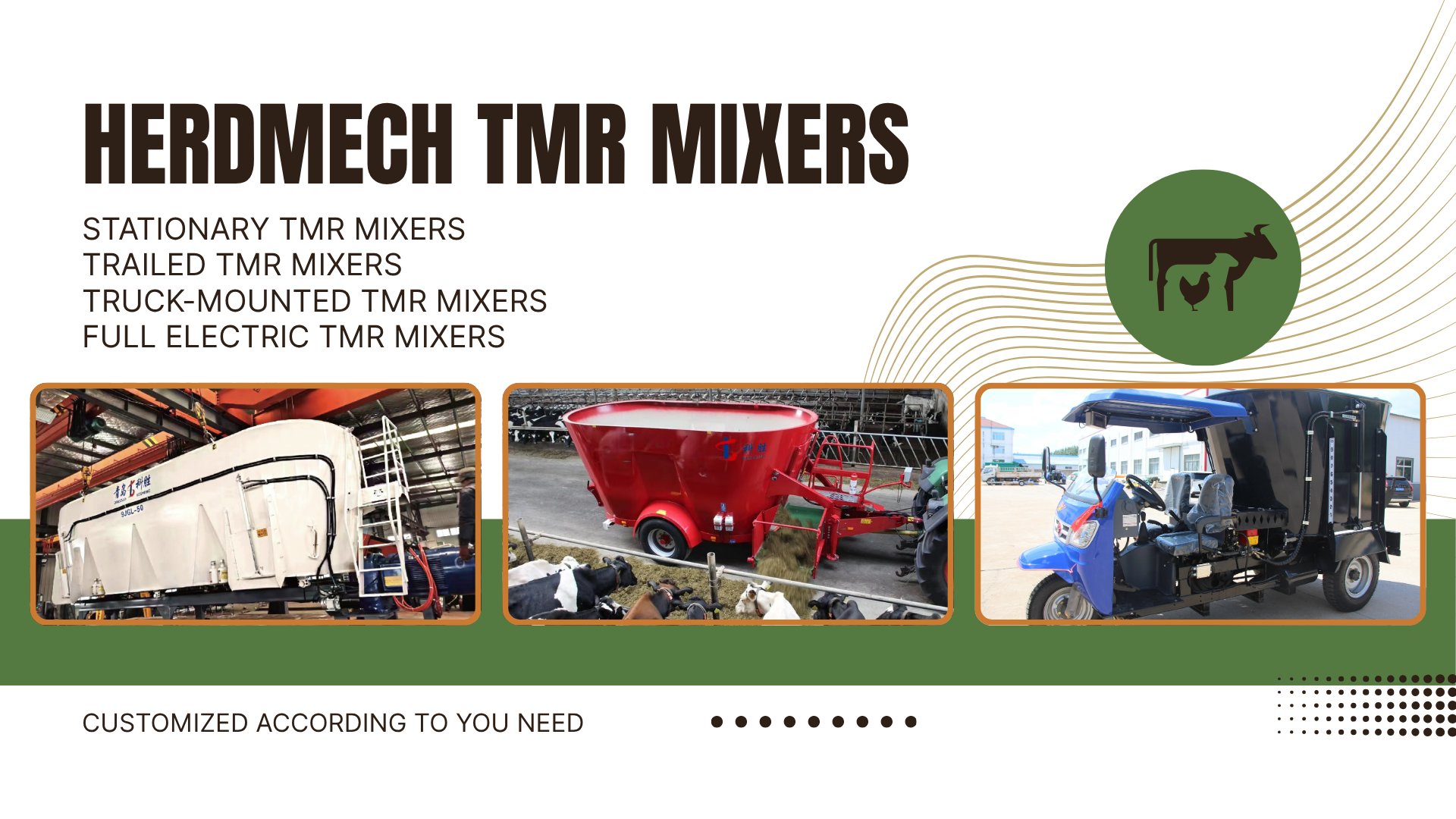
The 3-Step Formula to Calculate TMR Mixer Size
You don't need a nutritionist or a spreadsheet to size a mixer correctly. Three numbers — head count, feeding frequency, and ration density — get you most of the way there.
Step 1: Calculate Total Daily Feed Demand
Multiply your head count in each group by its typical as-fed intake, then add the groups together. These are general working ranges — check your own feed sheets if you have them.
| Animal Group | Typical As-Fed Intake / Day |
|---|---|
| Lactating cows (high group) | 50–65 kg (110–145 lb) |
| Lactating cows (low group) | 45–55 kg (100–120 lb) |
| Dry cows | 35–45 kg (75–100 lb) |
| Heifers (12–24 months) | 25–35 kg (55–75 lb) |
| Calves on starter TMR | 8–15 kg (18–35 lb) |
Step 2: Decide Your Feeding Frequency
Most dairies feed 1–3 times per day, sometimes mixing different rations for different groups. The more separate batches you mix, the smaller each one can be relative to your total daily demand. Divide your total daily demand by the number of batches you'll actually mix per day.
Step 3: Convert Weight to Mixer Volume
TMR doesn't have a fixed density — chopped silage, dry hay, and concentrate pack very differently — but 350–450 kg per m³ (22–28 lb/ft³) is a reasonable working figure for a typical silage-based ration once mixed. Divide your per-batch weight by this density to get your working volume.
One more thing: never plan to fill a mixer to the brim. Vertical augers need headroom to actually tumble and blend the ration — that's what produces the fluffy, dead-zone-free mix that prevents sorting at the bunk. Plan to load no more than 80–85% of rated capacity, so divide your working volume by 0.8–0.85 to land on the rated capacity you should actually shop for.
Worked Example: 350-Head Dairy, Two Feedings a Day
50 dry cows × 40 kg = 2,000 kg
100 heifers × 30 kg = 3,000 kg
-------------------------------
Total daily demand = 16,600 kg
÷ 2 feedings = 8,300 kg / batch
÷ 400 kg/m³ density = 20.75 m³ working volume
÷ 0.85 fill rule ≈ 24.4 m³ rated capacity
This farm should be shopping in the 24 m³ class — a good fit for the Herdmech 9JQL-24 Trailed Mixer, a 9JCL-24 Truck-Mounted unit, or a 9JGL-25 Stationary Mixer if running a centralized feed center.
Quick-Reference TMR Mixer Sizing Chart
If you'd rather skip the math, here's a starting-point estimate by herd size, assuming a mixed group (milkers, dry cows, heifers) fed twice a day. Use this to narrow your search, then refine with Step 1–3 above.
| Herd Size | Working Capacity | Best-Fit Herdmech Models |
|---|---|---|
| 50–100 head | 6–8 m³ | Trailed 9JQL-06 / 9JQL-08 |
| 100–180 head | 10–12 m³ | Trailed 9JQL-10 / 9JQL-12 |
| 180–300 head | 16–20 m³ | Trailed 9JQL-16 / 9JQL-20, or Truck-Mounted 9JCL-16 |
| 300–450 head | 20–24 m³ | Trailed 9JQL-24, Truck-Mounted 9JCL-24, or Stationary 9JGL-25 |
| 450–700 head | 25–36 m³ | Stationary 9JGL-30 / 9JGL-36, or 25–33 m³ Full-Electric Truck-Mounted |
| 700+ head / centralized feed center | 36–50 m³ | Stationary 9JGL-50, or multiple stationary units running parallel batches |
Size Isn't the Only Decision — Choosing the Right Mixer Type
Two farms with identical herd sizes can need completely different mixers. Capacity tells you the volume; your layout, labor, and growth plan tell you the type.
Trailed TMR Mixers — small to medium dairies
PTO-driven and towed behind a tractor you already own (matched to 60–240 HP across the 9JQL 6–30 m³ range), trailed mixers are the lowest-cost entry point and the most maneuverable option for narrow barns and feed alleys. They're the default choice if you're feeding from a single site and want to keep capital costs down.
Stationary TMR Mixers — centralized feed centers
Electric-driven and built to stay in one place, the 9JGL 5–50 m³ series is the right call once you're running continuous, high-volume batches from a central feed center and distributing rations out to multiple barns by truck, cart, or conveyor. Lower running costs than diesel at this scale, and easier to integrate with automated feeding systems.
Truck-Mounted TMR Mixers — multi-site mobile feeding
Built on commercial chassis (Foton, Sinotruk, Shacman) with full PTO power, the 9JCL 16–24 m³ range mixes and delivers feed without needing a separate tractor, and covers ground between barns or satellite sites far faster than a trailed unit. The right middle ground for medium-to-large operations feeding more than one location.
Self-Propelled TMR Mixers — compact, single-operator feeding
The compact 9SCL 4–5 m³ models let one operator load, mix, and feed without leaving the seat. They're a strong fit for smaller herds, hospital and calf pens, or as a second unit alongside a larger mixer for satellite groups that don't need a full-size batch.
Buy for the Herd You'll Have, Not Just the One You Have Today
If you're planning to grow your herd over the next 2–3 years, size up rather than sizing exactly to today's headcount. Trading up a trailed or stationary mixer isn't a quick swap — it usually means a full feeding-routine change and downtime you'd rather avoid. A mixer running comfortably at 70–80% of its rated capacity today still has room to grow with you, without forcing an early replacement.
5 Sizing Mistakes That Quietly Cost Farms Money
- Sizing by headcount alone. A silage-heavy ration and a dry-hay-heavy ration pack to very different densities — the same herd can need a noticeably different mixer volume depending on what's in the ration.
- Overfilling a small mixer to save trips. Past about 85% capacity, augers can't fully tumble the load — you get an uneven mix, more sorting at the bunk, and faster wear on augers and blades.
- Mismatching tractor HP to mixer size. Each capacity class has a rated horsepower range for a reason — an underpowered tractor strains the gearbox and slows processing on every load.
- Ignoring barn and alley width. A trailed or truck-mounted unit that can't turn comfortably in your feed alley adds minutes — and risk — to every single feeding.
- Sizing for one big batch instead of total daily throughput. If you're already feeding 2–3 times a day, you may need far less per-batch capacity than your total herd size suggests.
Herdmech Trailed TMR Mixer Specifications at a Glance
Once you know your target capacity, here's exactly what you're matching it to. Every model in the lineup shares the same 14mm double-layer wear-resistant auger, 8mm tungsten-carbide coated blades, and NM400 wear-resistant steel chamber — only the dimensions, power, and auger count scale up.
| Model | Capacity | Rated HP | Augers | Blades | Weight (kg) |
|---|---|---|---|---|---|
| 9JQL-06 | 6 m³ | 60–80 | 1 | 8 | 2,160 |
| 9JQL-08 | 8 m³ | 80–100 | 1 | 8 | 2,580 |
| 9JQL-10 | 10 m³ | 100–120 | 1 | 8 | 2,980 |
| 9JQL-12 | 12 m³ | 120–140 | 1 | 10 | 3,580 |
| 9JQL-16 | 16 m³ | 140–160 | 2 | 16 | 4,280 |
| 9JQL-20 | 20 m³ | 160–180 | 2 | 16 | 6,230 |
| 9JQL-24 | 24 m³ | 180–200 | 2 | 16 | 6,530 |
| 9JQL-30 | 30 m³ | 200–240 | 2 | 20 | 7,800 |
Looking for the stationary, truck-mounted, or self-propelled lineup instead? Full specs for each are on their respective collection pages — see the links above.
Frequently Asked Questions
How many cubic meters of TMR mixer do I need for 100 dairy cows?
For a herd of roughly 100 milking cows fed twice a day, expect to land somewhere around 8–10 m³ of rated capacity, depending on ration density and how much of the herd is in other groups like dry cows or heifers. Run the Step 1–3 formula above with your actual numbers for a precise figure.
What's the difference between a trailed and a stationary TMR mixer?
A trailed TMR mixer is towed behind a tractor and moves with you between barns — lower cost, more flexible, ideal for single-site farms. A stationary TMR mixer is electric-driven and stays fixed at a centralized feed center, built for continuous high-volume mixing that's then distributed out to multiple barns.
Can I overfill a TMR mixer to save time?
It's not recommended. Past roughly 85% of rated capacity, the augers don't have enough headroom to fully tumble the ration, which leads to uneven mixing, more sorting at the bunk, and added wear on augers and blades over time.
How is TMR mixer capacity actually calculated?
Multiply head count by typical as-fed intake per group, divide by your number of daily feedings to get weight per batch, then divide by your ration's bulk density (roughly 350–450 kg/m³) to get working volume. Divide that by 0.8–0.85 to land on the rated capacity to shop for.
What horsepower tractor do I need for a 12m³ TMR mixer?
Herdmech's 9JQL-12 trailed mixer is rated for 120–140 PTO horsepower. Matching tractor power to the mixer's rated range protects the gearbox and keeps mixing and processing times consistent — going underpowered will strain the drivetrain and slow every load.
Still not sure which size fits your herd?
Tell us your herd size and current setup — our team will help you match the right model in under 24 hours.
Chat on WhatsApp Email Our Team