


How to choose a manure cleaning truck for free-stall barns
Cleaning width, turning radius and doorway clearance decide more about a barn cleaner than engine size. Here is how to measure the barn you actually have — before you compare a single model.
The short answer
Choose a self-propelled manure cleaning truck whose cleaning width fits your narrowest feed alley with 100–150 mm to spare, whose turning radius fits the cross alley at the end of it, and whose body height clears your lowest door header. Width, turning space and clearance come first; engine power and price come after them.
A fixed 2,100 mm machine suits standard 2.4–3 m alleys. A barn with drive-through alleys 3 m and wider needs an adjustable 2,500–4,200 mm machine — anything narrower wastes capacity, and anything wider simply will not fit between the kerbs.
Start with the job, not the spec sheet
What a manure cleaning truck actually does in a free-stall barn
A manure cleaning truck — also sold as a barn cleaner or manure collection machine — is a self-propelled diesel unit that drives the feed alley, lifts manure with a front-mounted collector, carries it in an enclosed body and discharges it with an auger. One operator, one pass, manure out of the barn and onto the trailer.
That differs from the routine most free-stall farms still run. A tractor with a scraper blade pushes manure along the alley to a cross channel or reception pit, which means the tractor and a driver are committed to barn work, the pushing surface wears as it scrapes, and everything ends up in a pit that has to be pumped and handled again.
A collection truck removes the material instead of relocating it inside the barn. The alley is left dry, the tractor stays free for feeding, and the load goes straight into a spreader or a storage ramp. In a free-stall shed, where cows walk the feed alley dozens of times a day, that difference shows up in footing: drier concrete means fewer slips and less slurry carried onto the cubicle kerb.
The trade-off is that you are buying a dedicated machine rather than using a tractor you already own. Whether that pays depends almost entirely on how wide your alleys are and how many of them you have to clean each day — which is why the measurements below come before any model comparison.
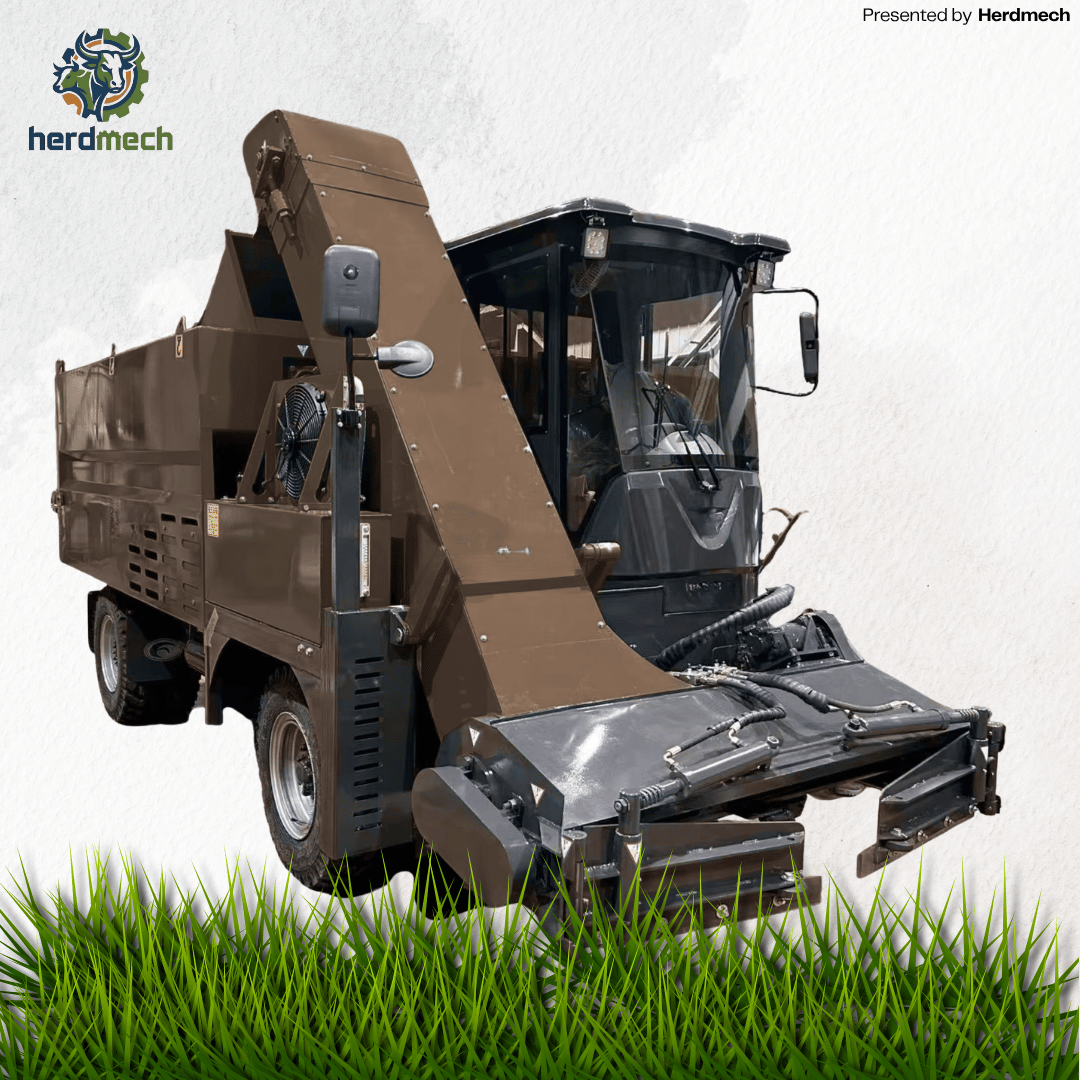
A front collector lifts and carries the load rather than pushing it — the alley behind the machine is left clean and dry.
Before you compare models
Six measurements to take in your barn
Walk the barn with a tape measure and a notebook. Every number below eliminates machines faster than any brochure can sell you one.
-
Cleaning width of the narrowest alley
Measure between kerbs, not between walls, at the tightest point — usually where a water trough, a gate post or a headlock frame narrows the feed table. The collector must fit with enough margin to steer, so a 2,400 mm alley wants a machine no wider than about 2,250 mm at the working edge.
-
Alley length and how many passes it takes
A 90 m alley cleaned twice a day is 180 m of travel per alley, per day. Count every alley in the shed and add the drive between them. This figure, not engine power, tells you how much of the working day the machine will occupy.
-
Turning space at the headland
Measure the clear width where the feed alley meets the cross alley. A machine with a 6,200 mm turning radius needs roughly that much clear ground to swing round; a 7,000 mm machine needs more. If the headland is tight, the choice is made for you.
-
Lowest overhead clearance
Check door headers, cable trays, water lines, fan housings and any ducting you drive under. Take the lowest point you will pass, not the average. A machine that clears by 50 mm is a machine that will eventually strike by 50 mm.
-
Floor type and what it will carry
Solid concrete is straightforward. Slatted floors and crossover slabs are not: a 7.4-tonne machine concentrates its weight on a small contact patch, and slat load ratings vary widely by manufacturer and age. Confirm the rating with whoever built or inspected the floor before you commit.
-
Where the manure goes when it leaves the alley
Ramp, reception pit, or straight into a spreader at the barn door. The discharge height and unloading method have to suit that destination — an auger unloading into a trailer at the door is very different from tipping onto a ramp.
Two models, one decision
The HerdMech QF series uses the same drive and unloading architecture across both models. What changes is width, physical size and power — and those three changes are what decide which barn each machine belongs in.
| Specification | QF-05 | QF-08 |
|---|---|---|
| Dimensions (L × W × H) | 4,850 × 1,800 × 2,550 mm | 5,750 × 2,520 × 2,800 mm |
| Cleaning width | 2,100 mm, fixed | 2,500 – 4,200 mm, adjustable |
| Engine power | 58 kW | 83 kW |
| Travel speed | 0 – 20 km/h | 0 – 20 km/h |
| Turning radius | 6,200 mm | 7,000 mm |
| Unloading method | Auger | Auger |
| Machine weight | 4.8 t | 7.4 t |
| List price | $20,000 | $40,000 |
Interpreting the table
What the numbers mean in a real barn
Both models share the same Yuchai diesel engine family, loader-grade torque converter, 32A chain conveyor, fully enclosed double-seal bearings and auger discharge. The practical differences sit in four rows of that table.
Cleaning width decides the barn, not the budget
A fixed 2,100 mm collector is right for a standard 2.4–3 m feed alley — one clean pass, no adjustment to think about, and a body narrow enough to fit between kerbs that were never designed for wide equipment. Set an adjustable machine to its 2,500 mm minimum in that same alley and you have gained nothing but 1.5 tonnes of steel to manoeuvre.
The QF-08 earns its place in drive-through and wide-alley sheds where the working width genuinely reaches 3.5–4.2 m. There, a fixed narrow machine means two passes down every alley, every day, and the extra labour quietly outweighs the price difference.
Physical size is not the same as working width
The QF-05 is 1,800 mm wide overall; the QF-08 is 2,520 mm. Those are the figures that decide whether a machine passes a doorway or a service gate. Height matters too: 2,550 mm against 2,800 mm is the difference between clearing a low header and not attempting the doorway at all. Measure the openings, not just the barn.
Power buys pushing force, not speed
Both machines travel at 0–20 km/h, so 58 kW against 83 kW is not about getting there faster. It is about maintaining pushing force through deep-bedded pack, a heavy fresh load, or a ramp out of the barn. On a well-scraped solid floor with daily cleaning, the smaller engine does the job comfortably.
Weight is a structural question
4.8 tonnes and 7.4 tonnes are both point loads on whatever floor they cross. On solid concrete this is unremarkable. On slats, on a crossover slab, or on an older ramp, it is a question for an engineer rather than a salesman — and it is the single most common reason a farm ends up buying the smaller model on purpose.
The price gap is a width-and-scale decision
Doubling the price buys an adjustable 1.7 m of working width, 25 kW more power and a heavier chassis. That is good value for a 400-cow unit cleaning four wide alleys, and poor value for an 80-cow barn where one narrow alley is the whole job.
When a manure cleaning truck is the wrong purchase
It is worth saying plainly: this is not a machine every free-stall barn needs. It is the wrong buy in five situations.
Skip it if any of these describe your barn
- The barn is fully slatted. Manure drops through the floor rather than sitting in the alley, so there is little to collect — and 7.4 tonnes of steel on slats deserves a structural opinion before it deserves a quotation.
- The herd is small and labour is cheap. Below roughly 40–50 cows in a single alley, a tractor and blade, or a hand scrape, usually costs less over five years than a dedicated machine.
- The alley is narrower than the machine, or the headland is tighter than the turning radius. A machine you cannot turn is a machine that blocks the barn at the worst possible moment.
- Ceiling or doorway clearance falls under about 2.8 m along any part of the route. Check the low points before anything else; there is no adjustment for a beam.
- Your actual problem is slurry volume, not alley cleanliness. If the pit is overflowing and bedding costs are climbing, the answer is a solid-liquid separator downstream — not another machine in the alley. See turning cow manure into fertilizer for the full route.
Fit
Which farms this machine actually suits
In practice, four types of operation get the most out of a self-propelled barn cleaner. If you recognise yourself in one of them, the decision is mostly about which model.
60–200 cow free-stall herds with one or two standard alleys
Solid concrete feed alley of 2.4–3 m, cleaned once or twice a day by one person. The QF-05 replaces 45 minutes of scraping with a single pass, fits between the kerbs without adjustment, and does not demand a reinforced floor. This is the classic fit for the smaller machine.
200–600 cow units with drive-through alleys of 3.5–4.2 m
Multiple wide alleys, several passes per alley, and a crew whose time is better spent on cows than on scraping. The adjustable 2,500–4,200 mm width covers the full alley in one pass, and the 83 kW engine keeps pushing force steady through a heavy load.
Mixed and converted sheds with irregular layouts
Converted tie-stall buildings, beef sheds and mixed grazing units rarely have a textbook alley. An adjustable-width machine handles the variation; a narrow fixed machine handles the tight corners. Measure the worst point in the building, not the best.
Contractors and multi-barn operations
If one machine serves several barns, travel at 0–20 km/h and the loader-grade drive axle matter as much as cleaning width. Shared machines should be specified for the widest alley they will meet, then adjusted down for the narrow ones.
Due diligence
Six questions worth asking any dealer
Specification sheets are easy to compare. Support is not. Ask these before you sign, whichever brand you choose.
- What is the chain and bearing specification? Conveyor chain grade and bearing sealing decide how often the machine stops. A 32A chain and fully enclosed double-seal bearings are a reasonable benchmark for barn conditions.
- How is the machine unloaded, and at what height? Auger discharge into a trailer at the door is not the same as tipping onto a ramp. Confirm the geometry against your own yard.
- Who services the engine locally? A common industrial diesel with a wide service network is worth more in year four than a slightly better spec sheet in year one.
- Can you supply wear parts from stock? Ask for the lead time on the collector edge, chain and seals, in writing.
- Will you measure the barn with me? A supplier who wants alley widths, headland space and clearance figures before quoting is a supplier who has installed these before.
- What is the floor loading, and what does the manual say about slats? Get the answer in writing and pass it to whoever assesses your floor.
Send us your alley widths and we will tell you which model fits
Two numbers are usually enough to start: the width between kerbs at your narrowest point, and the clear space at the headland. We will come back with a model recommendation and the measurements that drove it.
Frequently asked questions
How wide should a manure cleaning truck be for my alley?
Roughly 100–150 mm narrower than the clear width between kerbs at the tightest point in the alley. A 2,400 mm alley takes a machine working at about 2,250 mm; a 2,100 mm fixed collector suits standard 2.4–3 m alleys. If your alleys vary by more than half a metre, an adjustable-width machine is worth the extra cost.
Can a manure cleaning truck be used on slatted floors?
Only after the floor has been assessed for the machine's weight — 4.8 tonnes for the smaller model, 7.4 tonnes for the larger one. Slat load ratings vary by manufacturer and age, and most barns were not designed with a self-propelled vehicle driving over them. Slatted barns also generate less manure in the alley to collect in the first place, so the return is weaker.
What is the difference between a manure cleaning truck and a tractor scraper?
A scraper pushes manure along the alley into a cross channel or pit, so the material stays in the barn system and the tractor is tied up for the job. A collection truck lifts the manure, carries it in an enclosed body and unloads it outside, leaving the alley dry and freeing the tractor for feeding.
How often should a free-stall alley be cleaned?
Most free-stall operations clean the feed alley two to three times a day to keep footing dry and reduce slurry carried onto cubicle kerbs. The machine's value comes from making that frequency realistic with one operator — not from cleaning less often.
Do I need a dewatering machine as well?
They solve different problems. A cleaning truck removes manure from the alley. A screw-press solid-liquid separator deals with what arrives at the pit — reducing slurry volume and producing separated solids that can be reused as bedding. Farms with a full pit and rising bedding costs usually need the separator; farms with wet alleys need the truck.
What turning space does the machine need at the end of the alley?
Budget for the turning radius plus a margin for the operator: about 6.2 m of clear ground for the QF-05 and 7.0 m for the QF-08. Where the headland is tighter, the practical answer is usually the smaller machine rather than a more manoeuvrable large one.