


How to calculate TMR mixer ROI for a 500-cow dairy farm
A precision TMR mixer is one of the few pieces of dairy equipment that pays for itself out of the feed bill alone.
If you run a 500-cow dairy, feed is almost certainly your single largest expense — typically 50-60% of total production cost. That means the mixer you use to build every load of Total Mixed Ration isn't just "equipment." It's a daily control point for feed shrink, milk yield consistency, and labor hours. Yet most farms buy a TMR mixer based on gut feel or what the neighbor runs, not on a real return-on-investment calculation.
This guide walks through the exact formula, a worked example sized for a 500-cow herd, and which mixer configuration typically makes sense at that scale — so you can build your own numbers before you buy.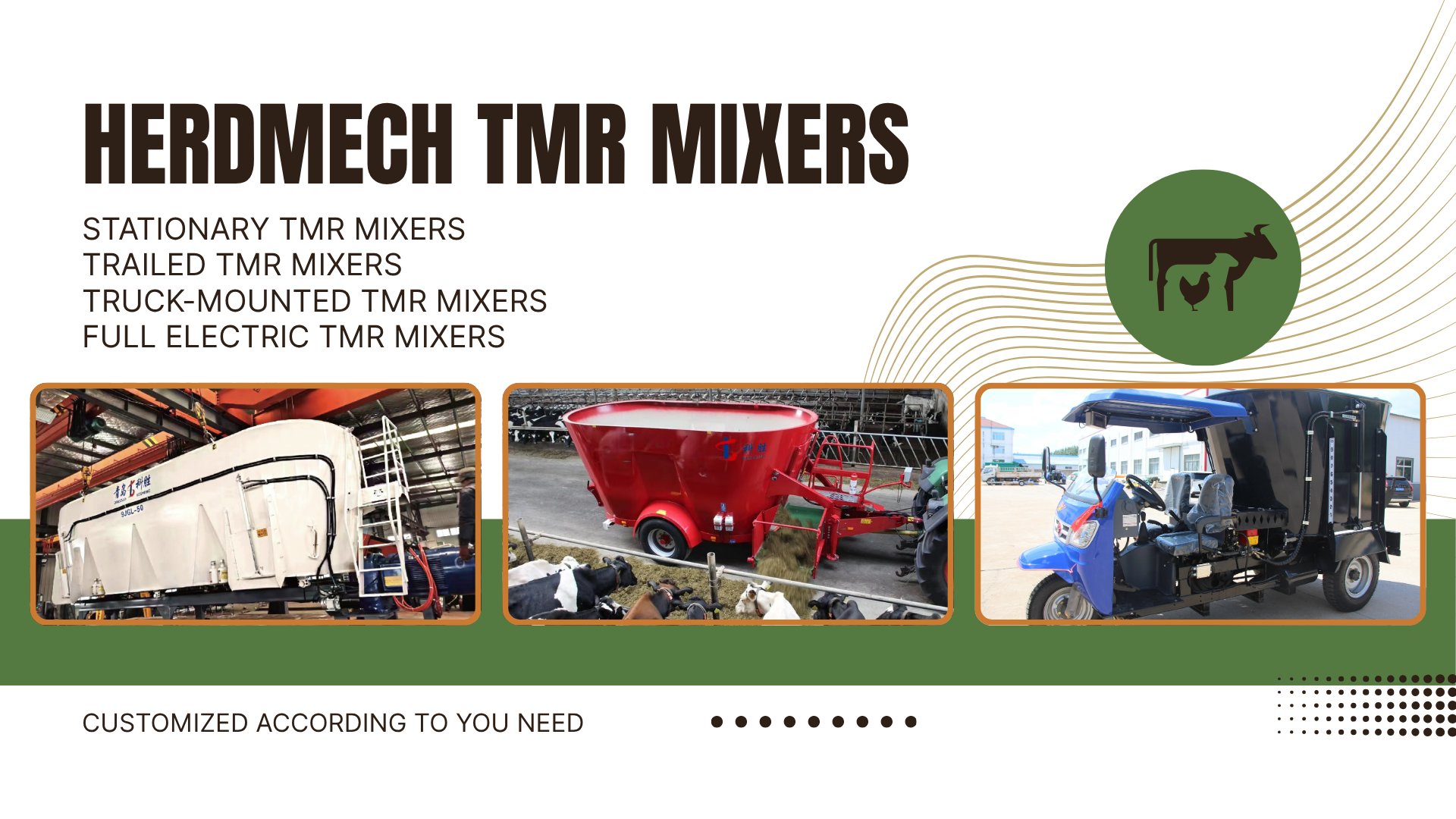
Quick answer
TMR Mixer ROI = (Annual Savings from reduced feed shrink, better milk yield consistency, and lower labor) ÷ Total Investment Cost. For a typical 500-cow dairy upgrading to a precision vertical mixer, the payback period usually lands between 6 and 18 months, depending on your current feeding method, feed cost, and milk price. A full worked example is below.
In this article:
Why TMR Mixer ROI Matters at 500 Cows
Dairy has consolidated hard over the last three decades — the U.S. midpoint herd size has moved from roughly 80 cows in the late 1980s to well over 900 cows today, and more than half of all U.S. dairy cows now live on farms of 500 head or more. In the West, that figure is closer to 80%.
In other words, a 500-cow farm is no longer a "big" outlier — it's the new middle of the industry. And at that scale, small percentage differences turn into real dollars fast. A 4-percentage-point improvement in feed efficiency on a 200-cow farm is a rounding error. On a 500-cow farm feeding 12-13 tons of TMR a day, it's tens of thousands of dollars a year — which is exactly why ROI math matters more, not less, once you cross a few hundred head.
The TMR Mixer ROI Formula
Two numbers matter: how fast the mixer pays for itself, and what it returns after that. Both formulas are simple:
Payback Period (months) =
Total Investment Cost ÷ Annual Net Savings × 12
ROI (%) =
(Annual Net Savings × Years Owned − Total Investment Cost) ÷ Total Investment Cost × 100
Total Investment Cost includes the mixer itself, any tractor or truck chassis needed, delivery/import costs, installation, and financing costs if applicable.
Annual Net Savings is the sum of every place a better mixer reduces cost or increases revenue — which is the part most farms underestimate. That's the next section.
Where a TMR Mixer Actually Recovers Its Cost
A mixer's ROI rarely comes from one dramatic number — it comes from four smaller, very real ones stacking together.
1. Feed shrink and loading accuracy
Shrink — feed lost to spillage, over-mixing, poor loading order, or inaccurate scales — is one of the most measurable costs on a dairy. Published research on commercial dairies has found shrink for stored commodities and mineral supplements typically running in the 2-15% range depending on the ingredient and storage method, and dramatically higher for wet byproducts stored improperly. Feeding methods matter too: studies comparing forage handling methods found unrolling round bales on the ground wasted 22-23% of the feed, while shredding onto the ground still wasted 13-16% — losses a properly sized TMR mixer with an accurate weighing system largely eliminates.
An older mixer with a worn auger, an under-sized chamber for your batch size, or a scale that's out of calibration can quietly push shrink well above what your ration sheet assumes — meaning the cows never actually receive the diet your nutritionist formulated.
2. Sorting and refusals
When a ration isn't cut and blended evenly, cows sort — they eat the tasty concentrate first and leave the long fiber behind. That means the first cow at the bunk and the last cow at the bunk are eating two different diets from the same "batch." A fluffy, uniform, dead-zone-free mix (the entire point of a well-designed auger and blade system) keeps every bite consistent, which reduces both sorting losses and the digestive upsets that come with it.
3. Milk yield consistency
Ration consistency shows up directly in the bulk tank. Field comparisons of feeding strategies have reported that farms moving to well-managed TMR feeding from component or partial-mix feeding saw milk yield gains in the range of roughly 1-3 kg (about 2-6.5 lb) of milk per cow per day, alongside feed savings of roughly $0.50-0.75 per cow per day. Those numbers vary a lot by farm and starting point, which is exactly why the worked example below uses a deliberately conservative estimate.
4. Labor hours
A mixer sized correctly for your herd — so you're running one or two batches a day instead of three or four, and not stopping to manually top-dress ingredients that didn't blend in — saves real labor minutes, every single day, all year.
Step-by-Step: A 500-Cow Worked Example
Below is a full worked example using conservative, round assumptions. Swap in your own farm's numbers — feed cost, milk price, and current shrink rate all vary — but the structure of the calculation stays the same.
Step 1: Set your assumptions
| Assumption | Example Value |
|---|---|
| Milking herd size | 500 cows |
| Average feed cost per cow/day | $6.50 |
| Milk price (blend, per cwt) | $19.50 ($0.195/lb) |
| Current avoidable feed loss (shrink + sorting) | ~8% |
| Expected avoidable loss after upgrade | ~4% |
| Conservative milk yield gain | +1.1 lb/cow/day |
| Labor time saved | 45 min/day at $18/hr |
These are deliberately conservative, illustrative figures — not a guarantee. Replace them with your own actual feed cost, milk check, and current shrink rate for an accurate result.
Step 2: Calculate annual savings
| Savings Source | Calculation | Annual Value |
|---|---|---|
| Reduced feed shrink | 500 × $6.50 × 365 × 4% | $47,450 |
| Milk yield gain | 500 × 1.1 lb × $0.195 × 365 | $39,150 |
| Labor savings | 0.75 hr × $18 × 365 | $4,930 |
| Total Annual Net Savings | $91,530 |
Step 3: Calculate payback period and ROI
For a herd this size, a 16-24 m³ single-pass mixer sized to feed the whole group in one or two loads is a common fit — Herdmech's Truck-Mounted TMR Mixer (16-24 CBM) lists at $59,900 as a reference point.
| Metric | Result |
|---|---|
| Investment cost | $59,900 |
| Annual net savings | $91,530 |
| Payback period | ≈ 7.9 months |
| Year 1 net return | ≈ 53% |
| 3-year cumulative ROI | ≈ 358% |
This example is illustrative, not a guarantee of results — your actual feed cost, milk price, herd management, and starting equipment will change these numbers. If you're financing the purchase, add loan interest into the investment side of the equation and talk to your lender or accountant about how that affects your specific payback period.
Which TMR Mixer Fits a 500-Cow Operation?
The right mixer type depends on your labor model, barn layout, and whether you already own a suitable tractor. Here's how Herdmech's four TMR mixer lines typically map to a 500-cow herd:
| Mixer Type | Best For | Typical Fit at 500 Cows |
|---|---|---|
| Trailed (PTO) | Farms with an existing 140-240 HP tractor | 16-20 m³ dual-auger model, lowest capital cost |
| Truck-Mounted | Single-operator, one-pass feeding | 16-24 CBM, feeds full herd in one to two loads |
| Self-Propelled | Tight barns, no spare tractor available | Best for multi-group feeding in narrow aisles |
| Stationary | Centralized feed centers, multiple pens | Pairs with a feed truck for herds split across groups |

As a sizing rule of thumb: match batch volume to the number of feedings you actually run. A 500-cow herd fed once a day at roughly 50-55 lb of as-fed TMR per cow needs somewhere around 12-13 tons of feed daily; splitting that into two batches (fresh cows vs. main herd, for example) generally calls for a 16-20 m³ mixer, while single-pass whole-herd feeding favors the 20-24 m³ range. Send us your feeding schedule and ration density and we'll help you size it precisely rather than guess.
FAQ
What size TMR mixer do I need for 500 cows?
Most 500-cow herds run a 16-24 m³ mixer, whether trailed, truck-mounted, or self-propelled — sized to cover the whole herd in one or two batches per day. Exact sizing depends on ration density, number of feeding groups, and feedings per day.
How much does a TMR mixer cost?
Pricing spans a wide range: compact self-propelled units start around $7,600-$10,200, mid-size truck-mounted mixers sized for 500-cow herds run roughly $55,000-$65,000, and large full-electric truck-mounted systems can exceed $150,000. Trailed (PTO) mixers are generally the lowest-cost path if you already own a suitable tractor.
How long does it take a TMR mixer to pay for itself?
For a 500-cow herd upgrading from an inaccurate or undersized mixer, payback is commonly somewhere between 6 and 18 months once you account for reduced feed shrink, better milk yield consistency, and labor savings — see the full worked example above for the math.
What's the difference between trailed, truck-mounted, self-propelled, and stationary TMR mixers?
Trailed mixers are pulled by your own tractor and are the most economical entry point. Truck-mounted mixers are self-contained and built for single-operator, one-pass feeding. Self-propelled mixers maneuver tight barns without needing a separate tractor. Stationary mixers sit at a central feed center and pair with a feed truck — best for farms feeding multiple pens or groups from one mixing point.
Not sure which mixer sizes right for your herd?
Tell us your herd size, ration, and feeding schedule — we'll help you size the right TMR mixer and give you a real cost quote.
Get a Free Sizing & QuoteFurther reading: Penn State Extension — Total Mixed Rations for Dairy Cows · Journal of Dairy Science — Feed Shrink and Weighing Accuracy Study